
doloop is not the star. You are. You bring us in the way you bring in the one colleague who reads the change before it merges and tells you straight, with no stake in making you feel good. We sit outside your AI and check what it made against your own rules. Same read every time. That is the whole job.
Two habits, held at once. We anticipate: we learn the conventions of your codebase, the voice of your writing, the shape of your documents, and we hand you the one change that fits, not a lecture. And we do not flatter. The verdict is the verdict, the same whether you run it now or next quarter, whether you want to hear it or not. You stay the one who decides. We just make sure you decide with your eyes open.
A thing that wrote the work cannot be trusted to grade it. The read has to come from outside the loop.
Same input, same verdict, every run. You can replay it and audit it. You can't replay a model's mood.
The dangerous output compiles and reads fine and still breaks the unwritten rules of your codebase, your deal, your voice.
When we can't prove an answer, the cell stays empty and the model stays quiet. Silence beats a confident guess.
We never touch your AI bill. You bring the model that writes the volume; we bring the outside read.
We make the unfamiliar legible and route only the exceptions to you, so you stay in command of the 100x.
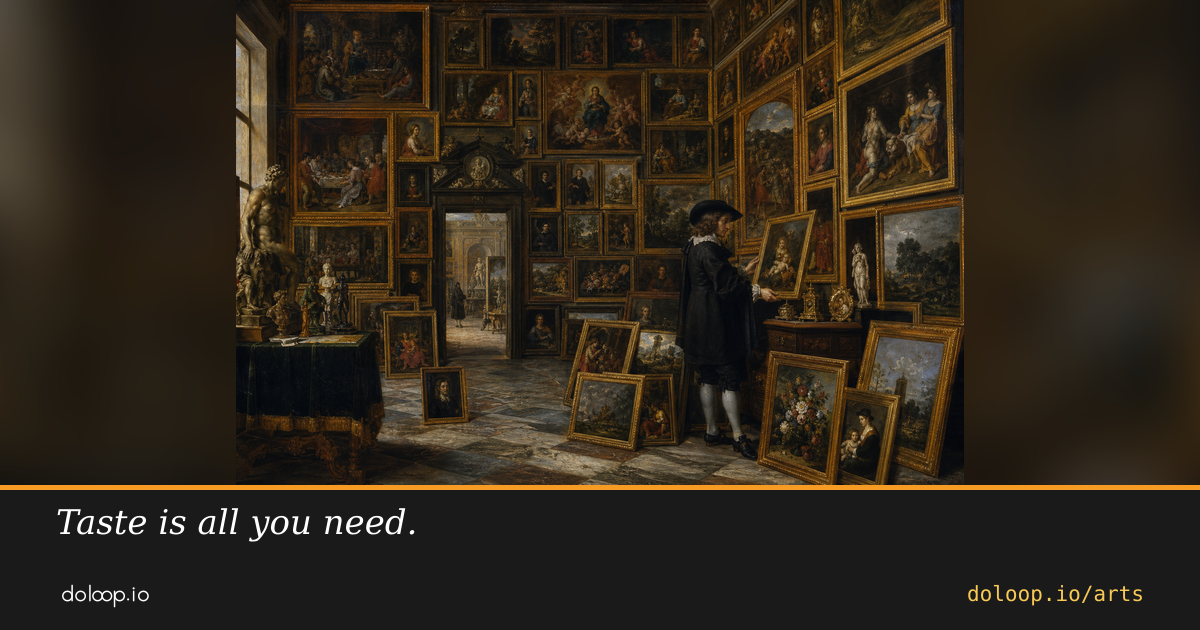
Every page we ship carries a real image, picked by hand. A Hokusai wave, a Ming scroll, a single-line bull. Not a generated gradient to fill the slot. It is the same discernment DOMAINS measures in writing, turned on our own work. Taste is the one part a machine can't hand you, and the part a reader feels first. So we keep it. See the gallery.
Where the rest of it lives, if you like to poke around.
Routes you to a real doloop page, asks when your question is ambiguous, or tells you when there is no answer. No model runs on the answer path, so it cannot invent one.